

How the world works now
by Dan Eden I'm going to tell you something that may surprise you. No, it's not about Depleted Uranium weapons. You've probably already heard about them from some conspiracy theory web site. It's even more horrible that you can imagine. No. I'm going to tell you about somehing else. I'm going to explain why you never see a story about Depleted Uranium on CNN, or NBC, FOX, CBS or any of the places where most Americans get their news about what's happening in the world. I'll even go one better -- I'll tell you why you don't often see a web site like this one -- viewzone -- with headline stories about these kinds of atrocities. It's quite simple. You know the answer: money. Just have a look at this page. The story you are reading is called the "content." But you will see that on the top and the left side there are banners. That's what keep this web site alive. Viewzone get a few cents every time you click on one of them. It's the same story with television. The program you tune in to watch is also the "content" and the stuff that interrupts it, the commercials, pays for that content. For television commercials, the network gets paid whether or not you buy the product that's being advertised. With the internet the advertisers only pay if you click on an ad banner. Just displaying it pays nothing. So here's how it works: When the editor places a page on viewzone.com, there's a bit of code that goes where the banners are positioned. When you click on the link to the story, the code sends a signal to the ad provider that someone wants to read it. The ad provider has a powerful computer that quickly "reads" the story and determines what it's about. Then its computer decides what kind of product a person reading the story would be interested in and sends the appropriate banner to appear on the page. It all happens instantaneously and efficiently. The problem is that no advertiser wants to be associated with "bad news" -- unless they have some product that they can sell you. Deformed babies in Iraq, poisoned by US depleted uranium shells, doesn't sell anything. Instead of some product, the ad provider will usually display a community service ad which pays nothing. Putting pages up about these kinds of topics is a net loss for viewzone -- as it is for CNN and all the other media that depend on advertising dollars. You see? It's not a conspiracy or censorship that prevents the truth from reaching people. It's the same thing that drives everything in the world today -- money.
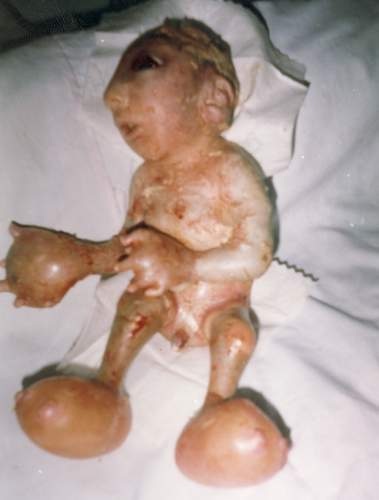
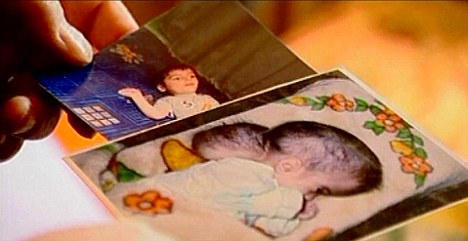
Your Tax Dollars At Work. Toxic munitions cause of baby deaths and deformities in Fallujah By David Randall In September this year, 170 children were born at Fallujah General Hospital, 24 per cent of whom died within seven days. Three-quarters of these exhibited deformities, including "children born with two heads, no heads, a single eye in their foreheads, or missing limbs". The comparable data for August 2002 -- before the invasion -- records 530 births, of whom six died and only one of whom was deformed.
The campaigners' letter to the UN calls for an independent investigation to be set up, "the cleaning up of toxic materials used by the occupying forces, including depleted uranium and white phosphorus", and an inquiry launched to discover if any war crimes have been committed. The campaigners believe that either white phosphorus or depleted uranium is a major, if not only, cause of the birth defects. White phosphorus, which US military has admitted firing on insurgents in heavily populated Fallujah, has a long history of military use, dating back to the First World War. And although no scientific study has ever proved a causal link between depleted uranium and serious medical problems – and several studies seem to have proved the opposite -- it is by no means in the clear. Ever since the first Gulf War, its use has been linked to cancers among returning troops.
 Birth defects of late from American DU shelling in Iraq
But, hey, it's cheaper than shipping those spent nuclear reactor rods to the toxic waste site. And the American people won't make a fuss, even if they know about it. -- right? Somehow it must be OK. I mean they're not white or Jews. They're just Arabs. Just imagine how the media would be covering this story if it was happening to Israelis, French or Americans. Why is that so?  Birth defects: A Fallujah mother holds her little girl, who was born without a left forearm and hand.
Collateral damage? Another Fallujah youngster born with six fingers on one hand.
A photograph of another disabled youngster born since the American assault on Fallujah.
Mother's agony: BBC World Affairs Editor John Simpson is shown photographs of children with birth defects in the Fallujah clinic.
Curse of Fallujah: This little girl was born with deformed feet.
Mystery: An infant born with just one eye battling to stay alive in the Fallujah clinic.
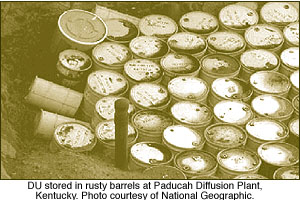
Lies and more lies... until you believe them Governments have largely ignored the serious dangers this recycled fuel represents. A common defence used by the British and US governments and their militaries is to claim that depleted uranium is less radioactive than natural uranium and therefore does not constitute a risk to human health. Duh! Not that lie again! Listen, poppy seeds on my sandwich contain traces of morphine. The poppy plant is where we get morphine and codeine. But there's a big difference between eating a handful of seeds and taking the condensed and refined drug. It's the same with depleted uranium. Sure, they're both uranium, but the amounts found naturally in stones and rocks would hardly raise a few clicks on a geiger counter. Yes, they DO believe we are stupid! In May 2003 Scott Peterson, a writer with the US newspaper CSM, examined radioactivity levels next to DU bullets in Baghdad and found Geiger-counter readings were 1900 times greater than background radiation levels next to DU bullets! When natural uranium is concentrated in a similar form to 'depleted' uranium it emits about 40% more alpha radiation, 15% more gamma radiation and around the same level of beta radiation. The chemical toxicity of uranium does not depend on the isotope, therefore enriched, 'normal', and depleted uranium are equally toxic chemically. It is extremely difficult and expensive for the nuclear industry to store DU. It is thought that the US currently has 1 billion tonnes of depleted uranium radioactive waste, while the UK has at least 50,000 tonnes. This waste is stored in cylinders at many sites across the US and UK and is vulnerable to corrosion and leaks owing to ageing cylinders and outside storage. It is stored mainly in the form of depleted uranium hexafluoride (DUF6) which can leak if the corroding cylinders are breached. At least 10 cylinders are known to have breached during the past 10 years.
Turning this DU waste into weapons solves some of the problem faced by the Government and nuclear industry, concerning what to do with these large stockpiles. Not only is DU practically free of charge for the arms manufacturers, but it no longer has to be stored and monitored indefinitely. Wow. That's great - eh?
 Depleted uranium is a risk to health both as a toxic heavy metal and as a radioactive substance. The UK and US Governments have long sought to play down these risks. The US and UK Governments claimed that DU presents no harm to soldiers or civilians, yet accumulating and alarming evidence from scientists, soldiers and activists has forced them to back down and recognise the risks posed. However what is clear from reading all major studies is that more research urgently needs to be done. There exists very little research publicly available on the effects of uranium contamination in humans and accurate tests to understand exposure doses from military uses of DU, almost certainly done secretly, have never been reported. How it get inside of you
As a DU penetrator hits its target some of the DU from the weapon reacts with the air in the ensuing fire and becomes a fine dust (often called an 'aerosol') that makes inhalation and ingestion a possibility for those in the area. Even after the dust has settled, the danger remains that it may be resuspended in the future by further activity or the wind, and again pose a threat to civilians and others for many years into the future. DU particles have been reported as travelling twenty-five miles on air currents. Open wounds also allow a gateway for DU into the body and some veterans have also been left with DU fragments in their bodies, remaining after combat. Inhaled DU dust will settle in the nose, mouth, lung, airways and guts. As a DU penetrator hits its target, the high temperatures caused by the impact ensure the DU dust particles become ceramic and therefore water insoluble. This means that, unlike other more soluble forms of uranium, DU will stay in the body for much longer periods of time. It cannot be flushed out. This aspect of uranium toxicology has often been ignored in studies of the health effects of DU, which base their excretion rates on soluble uranium. DU dust can remain in the sticky tissues of the lung and other organs such as the kidneys for many years -- just like asbestos. It is also deposited in the bones where it can remain for up to 25 years. This helps explain why studies of Gulf War veterans have found that soldiers are still excreting DU in their urine over 12 years after the 1991 conflict! Ingested DU can be incorporated into bone and from there will irradiate the bone marrow, increasing the risk of leukaemia and an impaired immune system.
External exposure to DU entails exposure to alpha, beta and gamma radiation. Although the skin will block alpha particles, beta and gamma radiation can penetrate beyond the dead outer skin layers and damage living tissue. Beta particles can penetrate to a depth of 2 cm, while gamma radiation (through a process called 'the Compton effect') generates beta particle radiation along its trajectory through the body. Neither is all external exposure to alpha radiation harmless. Cataracts, for example, can be caused by exposure to alpha radiation. Inside the body, DU poses a health risk in a variety of ways to different organs. The kidneys are the first organ to be damaged by DU. At a high dose kidney uranium levels can lead to kidney failure within a few days of exposure. Lower doses lead to kidney dysfunction, and can lead to an increased risk of kidney disease later in life. STOP! THIS IS IMPORTANT! You're sitting somewhere right now reading this. Maybe you're in your bedroom or office. Maybe you're a student in your dorm room. This all sounds horrible but it's so far away from you. It's "over there" and affecting babies and soldiers who look different from you. You live in a different world -- right? Just for a second, stop. This is America that is doing this -- our country -- and they are doing it draped in flags and stories about hero soldiers and fighting for our freedoms. But a shit house with fresh paint still stinks. They are using your tax money to do these things. Are you angry yet? Well how about those "heroes." The young kids of 18 who decide to make their family proud by joining the military. Good healthy kids who sign up and get shipped out. What about them? They get contaminated with radioactive DU powder and return home -- only to have our government deny that there is anything wrong with them or send them to psychiatric centers for imagining that they are sick. What about them? Still feel patriotic? Our government is broken. You can't write to complain to your Congressman. They throw your letters in the heap but have a red phone to their corporate sponsors. Even the President has forgotten his promises to the people. He ramped up the use of DU in Afghanistan and has just proposed building two new nuclear reactor sites in the Atlanta area. Change? So stop for a moment and get angry. But put a post-it note in your mind about what is happening. It's evil. Don't forget it. Try to do something about it.
Confirmed in Southern Iraq
ScienceDaily (Feb. 20, 2010) -- Childhood leukemia rates have more than doubled over the last 15 years in the southern Iraq province of Basrah, according to the study, "Trends in Childhood Leukaemia in Basrah, Iraq (1993-2007), published in the American Journal of Public Health.
The authors, three of whom are from the University of Washington, say they hope their calculations can now pave the way for an investigation into reasons why the rates have climbed so high, and why they are higher than found in nearby Kuwait, or in the European Union or the United States. The study documents 698 cases of leukemia for children aged 0-14 during the 15-year period, with a peak of 211 cases in 2006. Younger children had higher rates than older ones. "By using a hospital cancer registry, we were able to measure a jump in leukemia rates from 3 per 100,000 youngsters in the first part of our study period, to a rate of almost 8 and a half in the final three years," said UW Department of Global Health faculty member Amy Hagopian, the paper's lead author. By comparison, Hagopian said, the European Union and the United States report rates of 4 and 5 per 100,000, respectively. She also noted Kuwait reports a rate of approximately 2 per 100,000 and Oman reports rates between 2 and 3, depending on the gender of the child (boys typically have higher rates, as do children from higher socio-economic classes). "Studying childhood diseases in war situations is difficult," Hagopian noted. "Aside from the normal difficulties of controlling for referral patterns changes caused by war-time conditions, the political situation is also challenging. We were constantly worried about the political risks our medical colleagues were taking by collecting and reporting these data." Another author of the paper, UW Department of Epidemiology Chairman Scott Davis, noted, "Another challenge was securing population data for purposes of calculating rates." He said census data were not collected after the U.S. invasion of Iraq and population patterns were thought to be disrupted by migration patterns, as well. Study authors say they used the most conservative assumptions available, so as not to overstate their findings. The study was conceived by faculty at University of Washington and two Iraqi universities -- Mustansiriya University in Baghdad and Basrah University -- and the Fred Hutchinson Cancer Research Center in Seattle. The authors formed an ongoing partnership to support public health in Iraq after the 2003 U.S. invasion. During the period studied, Basrah and its highly populated surrounding area, which includes farmland and oil fields, became a modern battlefield, pummeled by three consecutive wars, including the Iran-Iraq war in the 1980s, the first U.S. invasion in 1991and the second U.S. invasion in 2003. The researchers now seek to understand the cause of Iraq's increased rate of child leukemia by conducting a case-control study to compare children who got leukemia with those who did not. That sort of study allows researchers to see if there were differences in exposures between the cases and the controls. Some increased exposures related to child leukemia could include the byproducts of regional petroleum fires and benzene, which comes from gasoline sold by children at the side of the road as a result of disrupted fuel supplies, war-related nerve agents and pesticides, and the widespread use of depleted uranium munitions. For more updated stories, see Article in Truthout
|
 The data -- contained in a letter sent by a group of British and Iraqi doctors and campaigners to the United Nations last month -- presaged claims made in a report in The Guardian yesterday that there has been a sharp rise in birth defects in the city. The paper quoted Fallujah General's director and senior specialist, Dr Ayman Qais, as saying: "We are seeing a very significant increase in central nervous system anomalies... There is also a very marked increase in the number of cases of brain tumours." Earlier this year Sky News reported a Fallujah grave-digger saying that, of the four or five new-born babies he buries every day, most have deformities. [right: Iraqi boys play with remains of US rocket.]




 U-238 is used to make 'depleted' uranium weapons. It is used for weapons because it is a heavy, dense
metal -- twice as dense as lead --and is judged by the army to be an excellent penetrator of enemy armour,
tanks, and even buildings. It's the weapon of choice for the A-10 Warthog aircraft.
U-238 is used to make 'depleted' uranium weapons. It is used for weapons because it is a heavy, dense
metal -- twice as dense as lead --and is judged by the army to be an excellent penetrator of enemy armour,
tanks, and even buildings. It's the weapon of choice for the A-10 Warthog aircraft.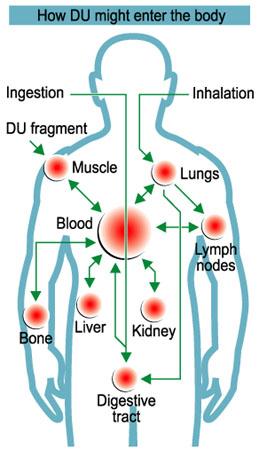 There are three main routes through which DU exposure on the battlefield takes place: inhalation, ingestion and wounding.
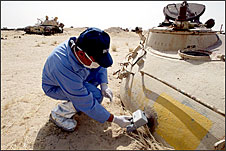 [Right: Dr. Khajak Vartaanian, a radiation expert, holds a Geiger counter next to a hole in an Iraqi tank destroyed by depleted uranium weapons in the Persian Gulf War in 1991. The shell holes show 1,000 times the normal background radiation level.]

Other health related articles on this site:
.
.
.
.
.
.
.
.
.
.
.
.
If you have a suggestion or health related article to submit, send it to:
Editor/viewzone.com
myristicin@hotmail.com