
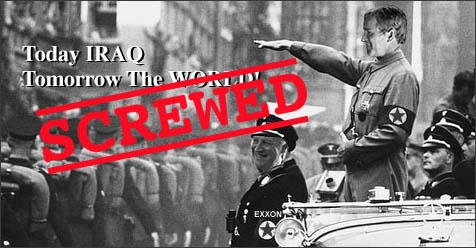
By Stephen Pizzo How extraordinary. Something is happening here that has never happened in America's history. A consensus is sweeping the nation. Not that the war in Iraq is wrong, or that oil companies are screwing us blue, or that the climate is going to hell, or that good-paying jobs are being replaced by low-paying jobs, or that our national health care system is a disgrace, or that that the rich are getting a lot richer while the middle class gets poorer. While all that's true, and more and more folks are getting it, that's not the consensus of which I speak. Nope. This one is bigger, enormous, huge! Here it is: The president of the United States is a moron. Yes, stupid, dumb as common road gravel. And not figuratively, but literally. George W. Bush, president of the world's last remaining superpower, is a moron. Forrest Gump's evil twin. I broached this possibility one year ago in a post entitled, "Bush: The Worst President Ever?" I was a bit early with that one. But what a difference a year makes! The cover story of this week's Rolling Stone Magazine reads, "The Worst President in History?" So the jury is in: Bush is a moron. If stupid is as stupid does, he's stupid. A botched war on terror, exploding debt, his "what me worry" response to Katrina - and the ongoing mismanagement of the recovery, North Korea has the bomb and Iran is on its way to its own nuke. Think about that for a second because it is definitive proof Bush is a moron. First he identifies three nations as his "Axis of Evil" in the world: North Korea, Iran and Iraq. Then he as a chance to whack one of the three, and he picks the only one that had no WMD. The only way he could look worse is if it were only two countries - a coin flip - and he still got it wrong. Yes, Virginia, the current occupant of the Oval Office is no longer a crook or an adulterer. He's a moron. As if that were not bad enough, we still face two and half years with this man at the controls. NFR reader Philip Bourgeois suggested an intervention launched by former Presidents Clinton, Bush Sr. and Carter. Not a bad idea, Phil. Poppa Bush must be beside himself watching his kid screw up decades of diplomacy in just five short years. He could take sonny into that Oval Office alcove where Monica used to dispense her favors and administer a few long overdue dope slaps. Bill Clinton could sit the moron down and give him a short course on how to balance a checkbook, teach him the difference between capital investment and undisciplined spending, and the virtues of saving for a rainy day. Jimmy Carter could teach Junior the actual meaning of the word "compassionate," and how to walk that walk. Carter could reveal to him that giving the already comfortably rich even more money is not compassion. Giving more money to the growing number of those who work 60 hours a week or more, and still can't get by, is "compassion." And he could figure out how to cover the nearly 50 million Americans who cannot afford health insurance. But none of that is likely to happen. One of the trademarks of a moron is contempt for facts that challenge the simple but comfortable fictions that rule their daily routines. You can drag a moron to a library, but you can't force him to learn. Bad To The Bone In fact morons get downright testy when someone challenges what they think they know. We saw this trait earlier this week when Bush was asked if he thought Don Rumsfeld should resign. The moron lashed out at the questioner, dashed into his imaginary phone booth and emerged as The Decider. "I'm the decider," he pronounced, with Mussolini-like swagger. You see, scratch a moron and beneath that smirking, ignorance-is-bliss exterior, you discover a fundamental truth: Beauty may be only skin deep, but moron goes right to the bone. I'm staying close to home until this guy is gone. Keeping my head down, my nose clean, and watching what I say in emails for friends. And I have a piece of advice for the Iranians too - this guy really is crazy enough to "decide" that bombing the shit out you is a good idea. Yes, Bush is exactly as stupid as he looks, sounds and acts. Doubt that at your peril. Fifty-one percent of American voters doubted it. And now we're screwed.
Stephen Pizzo is the author of numerous books, including "Inside Job: The Looting of America's Savings and Loans," which was nominated for a Pulitzer.
Could Bush Be Prosecuted for War Crimes?
By Jan Frel, AlterNet. Posted July 10, 2006.
A Nuremberg chief prosecutor says there is a case for trying Bush for the 'supreme crime against humanity, an illegal war of aggression against a sovereign nation.'
While the United States is a country like any other, its citizens no more special than any others on the planet, Americans still react with surprise at the suggestion that their country could be held responsible for something as heinous as a war crime.
From the massacre of more than 100,000 people in the Philippines to the first nuclear attack ever at Hiroshima to the unprovoked invasion of Baghdad, U.S.-sponsored violence doesn't feel as wrong and worthy of prosecution in internationally sanctioned criminal courts as the gory, bload-soaked atrocities of Congo, Darfur, Rwanda, and most certainly not the Nazis -- most certainly not. Howard Zinn recently described this as our "inability to think outside the boundaries of nationalism. We are penned in by the arrogant idea that this country is the center of the universe, exceptionally virtuous, admirable, superior."
Most Americans firmly believe there is nothing the United States or its political leadership could possibly do that could equate to the crimes of Hitler's Third Reich. The Nazis are our "gold standard of evil," as author John Dolan once put it.
But the truth is that we can, and we have -- most recently and significantly in Iraq. Perhaps no person on the planet is better equipped to identify and describe our crimes in Iraq than Benjamin Ferenccz, a former chief prosecutor of the Nuremberg Trials who successfully convicted 22 Nazi officers for their work in orchestrating death squads that killed more than one million people in the famous Einsatzgruppen Case. Ferencz, now 87, has gone on to become a founding father of the basis behind international law regarding war crimes, and his essays and legal work drawing from the Nuremberg trials and later the commission that established the International Criminal Court remain a lasting influence in that realm.
Ferencz's biggest contribution to the war crimes field is his assertion that an unprovoked or "aggressive" war is the highest crime against mankind. It was the decision to invade Iraq in 2003 that made possible the horrors of Abu Ghraib, the destruction of Fallouja and Ramadi, the tens of thousands of Iraqi deaths, civilian massacres like Haditha, and on and on. Ferencz believes that a "prima facie case can be made that the United States is guilty of the supreme crime against humanity, that being an illegal war of aggression against a sovereign nation."
Interviewed from his home in New York, Ferencz laid out a simple summary of the case:
Writing for the United Kingdom's Guardian, shortly before the 2003 invasion, international law expert Mark Littman echoed Ferencz: "The threatened war against Iraq will be a breach of the United Nations Charter and hence of international law unless it is authorized by a new and unambiguous resolution of the Security Council. The Charter is clear. No such war is permitted unless it is in self-defense or authorized by the Security Council."
Challenges to the legality of this war can also be found at the ground level. First Lt. Ehren Watada, the first U.S. commissioned officer to refuse to serve in Iraq, cites the rules of the U.N. Charter as a principle reason for his dissent.
Ferencz isn't using the invasion of Iraq as a convenient prop to exercise his longstanding American hatred: he has a decades-old paper trail of calls for every suspect of war crimes to be brought to international justice. When the United States captured Saddam Hussein in December 2003, Ferencz wrote that Hussein's offenses included "the supreme international crime of aggression, to a wide variety of crimes against humanity, and a long list of atrocities condemned by both international and national laws."
Ferencz isn't the first to make the suggestion that the United States has committed state-sponsored war crimes against another nation -- not only have leading war critics made this argument, but so had legal experts in the British government before the 2003 invasion. In a short essay in 2005, Ferencz lays out the inner deliberations of British and American officials as the preparations for the war were made:
U.K. military leaders had been calling for clear assurances that the war was legal under international law. They were very mindful that the treaty creating a new International Criminal Court (ICC) in The Hague had entered into force on July 1, 2002, with full support of the British government. Gen. Sir Mike Jackson, chief of the defense staff, was quoted as saying "I spent a good deal of time recently in the Balkans making sure Milosevic was put behind bars. I have no intention of ending up in the next cell to him in The Hague."
Ferencz quotes the British deputy legal adviser to the Foreign Ministry who, in the lead-up to the invasion, quit abruptly and wrote in her resignation letter: "I regret that I cannot agree that it is lawful to use force against Iraq without a second Security Council resolution ä [A]n unlawful use of force on such a scale amounts to the crime of aggression; nor can I agree with such action in circumstances that are so detrimental to the international order and the rule of law."
While the United Kingdom is a signatory of the ICC, and therefore under jurisdiction of that court, the United States is not, thanks to a Republican majority in Congress that has "attacks on America's sovereignty" and "manipulation by the United Nations" in its pantheon of knee-jerk neuroses. Ferencz concedes that even though Britain and its leadership could be prosecuted, the international legal climate isn't at a place where justice is blind enough to try it -- or as Ferencz put it, humanity isn't yet "civilized enough to prevent this type of illegal behavior." And Ferencz said that while he believes the United States is guilty of war crimes, "the international community is not sufficiently organized to prosecute such a case. ä There is no court at the moment that is competent to try that crime."
As Ferencz said, the world is still a long way away from establishing norms that put all nations under the rule of law, but the battle to do so is a worthy one: "There's no such thing as a war without atrocities, but war-making is the biggest atrocity of all."
The suggestion that the Bush administration's conduct in the "war on terror" amounts to a string of war crimes and human rights abuses is gaining credence in even the most ossified establishment circles of Washington. Justice Anthony Kennedy's opinion in the recent Hamdan v. Rumsfeld ruling by the Supreme Court suggests that Bush's attempt to ignore the Geneva Conventions in his approved treatment of terror suspects may leave him open to prosecution for war crimes. As Sidney Blumenthal points out, the court rejected Bush's attempt to ignore Common Article 3, which bans "cruel treatment and torture [and] outrages upon personal dignity, in particular humiliating and degrading treatment."
And since Congress enacted the Geneva Conventions, making them the law of the United States, any violations that Bush or any other American commits "are considered 'war crimes' punishable as federal offenses," as Justice Kennedy wrote.
George W. Bush in the dock facing a charge of war crimes? That's well beyond the scope of possibility ä or is it?
|
 The extent to which American exceptionalism is embedded in the national psyche is awesome to behold.