Share this article:          |
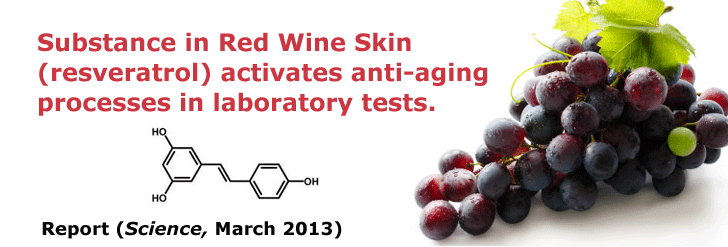
Mar. 7, 2013 -- A new study published in the March 2013 issue of Science demonstrates conclusive evidence that the red wine compound resveratrol directly activates a protein that promotes health and longevity in animal models.
What's more, the researchers have uncovered the molecular mechanism for this interaction, and show that a class of more potent drugs (currently in clinical trials) act in a similar fashion. Pharmaceutical compounds similar to resveratrol may potentially treat and prevent diseases related to aging in people.
We have already reported on the anti-aging affects of telomerase, which lengthens the critical ends of the DNA molecule that usually shorten and break, resulting in cell death. This new breakthrough affects not only the longevity of the cells but their vitality.
The science of aging has now turned its focus on situins, a group of genes that are believed to protect many organisms, including mammals, against diseases of aging. Mounting evidence has shown that resveratrol, a compound found in the skin of grapes as well as in peanuts and berries, increases the activity of a specific sirtuin known as SIRT1. This molecule protects the body from diseases by revving up the mitochondria, a kind of cellular battery that slowly runs down as we age. By recharging the batteries, SIRT1 can have profound effects on health. [1]
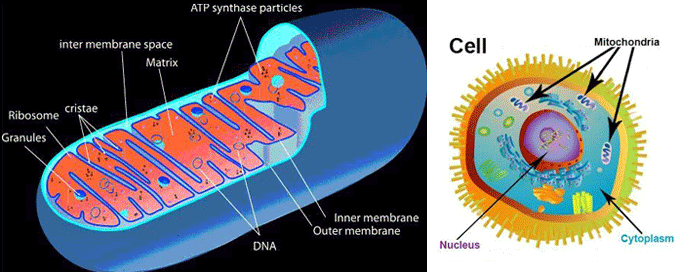 The mitochondrion is a power plant and an industrial park of the cell. It's where energy stored in the bonds of carbohydrates is converted to a form more useful to the cell (ATP). It's where certain essential biochemical conversions of amino acids and fatty acids occur. A cell uses energy to synthesize cell-specific materials that it can use for activities such as growth, reproduction, and movement. Energy is transformed from one form to another in mitochondria found in all eukaryotic cells. Sirtuin-1 is the protein created by the gene SRT1 which is able to recharge the aging mitochondria. Resveratrol, a substance found in red grape skins, activates this gene and increases the effeciveness of Sirtuin-1.
|
Animal experiments show extended lifespans
Experiments with mice on resveratrol have shown that they have twice the endurance of control mice. But what is more surprising is that they are relatively immune from negative effects of obesity and aging. So far, in experiments with yeast, nematodes, bees, flies and mice, lifespan has been significantly extended.
"In the history of pharmaceuticals, there has never been a drug that binds to a protein to make it run faster in the way that resveratrol activates SIRT1. Almost all drugs either slow or block them."
David Sinclair, Harvard Medical School professor of genetics and senior author on the paper.
In 2006, Sinclair's group published their first study showing that resveratrol could extend the lifespan of mice. They were so confident in their research that the team at Harvard Medical School established a pharmaceutical company called Sirtris Pharmaceuticals (now a GlaxoSmithKline company) and set out to make other drugs more potent than resveratrol.
Despite numerous studies reported by Sinclair's laboratories and other researchers, the claims that reservation could clinically increase the activity of SIRT1 was viewed with skepticism.
Weirdness in the laboratory...
The problem with Sinclair's experiments was in the way SIRT1 was studied in test tubes. These days, biologists can attach specific chemicals that will fluoresce under ultraviolet light. A specific chemical group was attached to the targets of SIRT1 so that they fluoresced more brightly as SIRT1 activity increased. This chemical group, however, is synthetic and does not exist in cells or in nature. Oddly, for some reason, the experiments did not work without this fluorescent chemical group!
As a response to this observation, a paper published in 2010 came to the conclusion that resveratrol's activation of SIRT1 was an experimental artifact -- at best an indirect result of resveratrol, and perhaps even a sheer coincidence. So the question remained: Does resveratrol directly activate SIRT1 or is the effect indirect?
"We had six years of work telling us that this was most definitely not an artifact. Still, we needed to figure out precisely how resveratrol works. The answer was extremely elegant."
--Sinclair
Slowly, the pieces come together...
 First, the team addressed the problem of the fluorescent chemical group. Why was it required for resveratrol to rev up SIRT1 in the test tube? Instead of dismissing the result as an artifact, the researchers surmised that the chemical might be mimicking molecules found naturally in the cell. These turned out to be a specific class of amino acid, the building blocks of proteins. In nature, there are three amino acids that resemble the fluorescent chemical group, one of which is tryptophan, a molecule abundant in turkey and notable for inducing drowsiness. When researchers repeated the experiment, swapping the fluorescing chemical group on the substrate with a tryptophan residue, resveratrol and similar molecules were once again able to activate SIRT1. [2]
This showed that there was a natural, as opposed to synthetic, molecule that could activate the SIRT1 and turn on the anti-aging process in cells.
"Next, we needed to identify precisely how resveratrol presses on SIRT1's accelerator."
According to ScienceDaily (2013), the team tested approximately 2,000 mutants of the SIRT1 gene, eventually identifying one mutant that completely blocked resveratrol's effect. The particular mutation resulted in the substitution of a single amino acid residue, out of the 747 that make up SIRT1. The researchers also tested hundreds of other molecules from the Sirtris library, many of which are far more powerful than resveratrol, against this mutant SIRT1. All failed to activate it.
The authors propose a model for how resveratrol works: When the molecule binds, a hinge flips, and SIRT1 becomes hyperactive.
Although these experiments occurred in a test tube, once the researchers identified the precise location of the accelerator pedal on SIRT1 -- and how to break it -- they could test their ideas in a cell. They replaced the normal SIRT1 gene in muscle and skin cells with the accelerator-dead mutant. Now they could test precisely whether resveratrol and the drugs in development work by tweaking SIRT1 (in which case they would not work) or one of the thousands of other proteins in a cell (in which they would work). While resveratrol and the drugs tested revved up mitochondria in normal cells (an effect caused activating by SIRT1), the mutant cells were completely immune.
"This was the killer experiment. There is no rational alternative explanation other than resveratrol directly activates SIRT1 in cells. Now that we know the exact location on SIRT1 where and how resveratrol works, we can engineer even better molecules that more precisely and effectively trigger the effects of resveratrol."
Sirtris Pharmaceutical currently has several variants of synthetic resveratrol in clinical trials at the present time. If you're wanting to get in early on this discovery then you might consider adding a glass of wint to your daily menu.
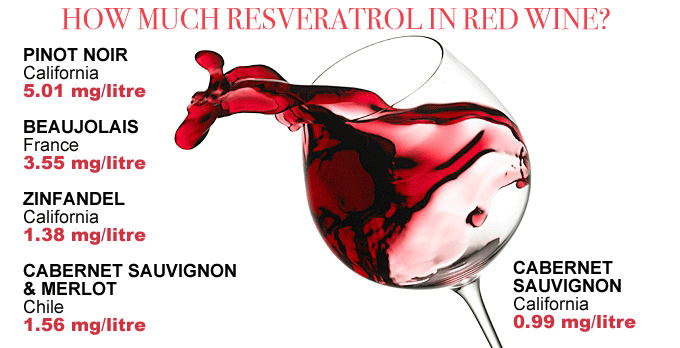
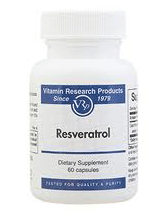 Also, a number of health food and vitamin stores are now carrying resveratrol as a supplement. Studies have shown that resveratrol can have beneficial cardiac effects (see The French Paradox where wine drinking seems to mitigate the rich and fatty diet of most French citizens) and, when given in large doses (3-5 grams daily) it lowered blood sugar significantly. [3]
As usual, pharmaceutical companies shy away from a natural ingredient with such strong positive claims. They work hard to manufacture something synthetic that can be patented and, although may be stronger than the natural source of resveratol, may not work in the same way.