


Share this article:          |
Biometrics: Psychopath's Wet Dream
What sort of mind needs to know absolutely everything about complete strangers, and to what end?
Clinically diagnosed psychopaths, those classified as biologically incapable of remorse, empathy or conscience from birth, are responsible for human suffering throughout history.
|
What is a Psychopath?
In very general terms, behaviors related to a modern concept of 'antisocial personality' or 'psychopath' have been recognized and recorded for ages. In a vignette contained in his ancient Greek work, The Unscrupulous Man, Theophrastus provided this description:
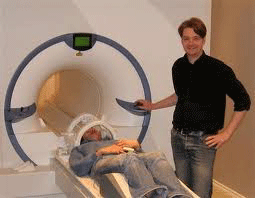
"will go and borrow more money from a creditor he has never paid ... When marketing he reminds the butcher of some service he has rendered him and, standing near the scales, throws in some meat, if he can, and a soup-bone. If he succeeds, so much the better; if not, he will snatch a piece of tripe and go off laughing". [1] Stories and legends containing figures of insanity (e.g. vagabonds, libertines, the 'mad') have often, at least since the 18th century, represented an image of darkness and threat to society, as would later 'the psychopath', a mixture of concepts of dangerousness, evil and illness. Psychopathy is defined by a pattern of interpersonal relationships, emotion, and behavior. Robert Hare [2] summarizes the syndrome as a cluster of related symptoms in two broad categories. The Emotional/Interpersonal aspect includes: Glib and superficial; Egocentric and grandiose; Lack of remorse or guilt; Lack of empathy; Deceitful and manipulative; Shallow emotions. The Social Deviance aspect includes: Impulsive; Poor behavior controls; Need for excitement; Lack of responsibility; Early behavior problems; Adult antisocial behavior. Hare summarizes the characteristics of a psychopath as follows: "What is missing, in other words, are the very qualities that allow a human being to live in social harmony... Those who doubt that such individuals exist need only consider the more dramatic examples of psychopathy that have been increasing in our society in recent years. Dozens of books, movies, and television programs, and hundreds of newspaper articles and headlines, tell the story..." [ibid] Hare also notes that some psychopaths can blend in, undetected, in a variety of surroundings, especially corporate environments. He has described psychopaths as "intraspecies predators".[3] Simon has also used the word predator to describe psychopaths.[4] Hare has said that "conceptualizing psychopaths as remorseless predators helped me to make sense of what often appears to be senseless behavior". He details what he sees as aspects of this, such as unempathic manipulation, selfishness, violating social norms, and instrumental violence -- meaning cold-blooded and casual. Psychopaths have different brains than the rest of us A team led by Professor Declan Murphy, Michael Craig and Marco Catani, of the Institute of Psychiatry at King''s College, London, compared the brain anatomy of pscyhopaths to that of ordinary people using a new scanning technique called diffusion tensor magnetic resonance imaging (DT-MRI). They recruited nine men who had been diagnosed as psychopaths, through mental health services, including people who had convictions for attempted murder, manslaughter, multiple rapes and false imprisonment. None was currently serving a prison sentence. Their brains were scanned using DT-MRI, and the results were compared with those obtained for normal volunteers of a similar age and IQ. The team found that a white-matter tract called the uncinate fasciculus (UF), which connects parts of the brain called the amygdala and the orbitofrontal cortex (OFC), differed significantly between the psychopaths and the control group. People who had been diagnosed with more extreme psychopathy showed greater degrees of abnormality in this tract. [5]
|
Magnetic Resonance Imaging (MRI / SPECT) scans of a psychopaths' brain reveal a lack of activity in areas responsible for spirituality, morals and ethics.

Psychopaths don't share these traits with other humans and use it to their advantage. The psychopath is a self-serving ego which simply does not care about his deceptive, thieving and recklessly destructive ways. Only he matters.
Know Thy Enemy
Popular psychopathic stereotypes are mistakenly limited to the serial killer. While all serial killers are psychopaths, very few psychopaths are serial killers. They are far more commonplace in society than previously thought.
Researcher Thomas Sheridan estimates that clinical psychopaths comprise about 4% of the population. Their distribution is not gender specific or limited to social strata.
Further, Sheridan explains that a secondary demographic exhibiting psychopathic traits exists. He assigns the term 'proto-psychopath' (learned or manufactured psychopathic personalities arising from upbringing, environment or training ). Unlike clinical psychopaths, these individuals (some employed as soldiers and police for example) can redeem their humanity through extensive counseling.
A psychopath considers other individuals as a literal 'human resource' to be used and discarded. Psychopaths, also known as inter-species predators, can lie with absolute impunity and are naturally obsessed with hierarchy. It should come as little surprise that they gravitate to and thrive in the areas of government, big business and high finance.
A psychopath's reward, much like a heroin addict's fix, is to exploit other individuals (or entire organizations.) Even the World would not be enough to satisfy a psychopath.
Leveraging Biometrics Into Society
If this plan is so devious why don't the people "do something" about it?
Rulers know most people are re-active, not pro-active. People don't react because they feel they don't have to. The silent cage door closes on the occupants (i.e. us).
Vladimir Lenin was quoted as saying: "Give us the child for eight years and it will be a Bolshevik forever". Today, school children from the youngest age are indoctrinated by government mandate to accept surveillance and to see privacy as a thing of the past.
A gradual societal phase-in of biometrics systems through a steady diet of carefully crafted government, corporate and media exposure acclimatizes the public to a system which labels and monitors them like chattel property. If we don't own ourselves, who does?
International bankster J.P. Morgan once said: "A man always has two reasons for doing anything - a good reason and the real reason".
Would prevention of "identity theft" and promotion of "safety & security from terrorists" provide excuse enough for cataloging and tracking the human race biometrically?
Facial recognition can be used to instantaneously scan a sports stadium full of people and locate a specific individual in the crowd. How difficult would it be to scan a crowd of protesters so they could easily be rounded up by authorities from their home or workplace afterward?
If senior citizens were required to provide an iris and thumb scan in order to qualify for (or receive) their pensions, could they refuse? Likewise, with welfare recipients transfer payments. Would there be recourse? Would access to health care be denied?
Humanity's Greatest Liberation
 Psychopaths fear exposure, which makes this is a positively exciting and empowering era for Mankind. The psychopaths can recognize one another but, at last, so can the rest of us.
For the first time in our history we can scientifically determine, through direct measurement (M.R.I. scan) and easily learned training (see Sheridan website below), to precisely identify the malevolent personas for what they are.
Let us not be the enablers psychopaths need.
By resisting participation in biometrics databases, Humanity throws sand into the surveillance apparatus, and like the parasite which keeps its host malnourished for selfish benefit, removal of the psychopath's influence from among us will unquestionably re-energize Mankinds' soul.
Notes:
[1] Millon, T., Simonsen, E., Birket-Smith, M. Historical Conceptions of Psychopathy in the United States and Europe. In T. Millon & E. Simonsen (Eds.) Psychopathy: Antisocial, criminal, and violent behavior New York, NY, US: Guildford Press
[2] Hare, Robert D. Without Conscience: The Disturbing World of Psychopaths Among Us, Page 2 (New York: Pocket Books, 1993)
[3] Ochberg FM, Brantley AC, Hare RD, et al. (2003). "Lethal predators: psychopathic, sadistic, and sane". International Journal of Emergency Mental Health 5 (3): 121–36. PMID 1460882
[4] Simon, R. I. Psychopaths, the predators among us. In R. I. Simon (Ed.) Bad Men Do What Good Men Dream (pp. 21-46). Washington: American Psychiatric Publishing, Inc.1996
[5] http://www.topnews.in/psychopaths-brains-are-differently-wired-2197285
COMMENTS: